
Improving Indoor Air Quality with Smart Ventilation

Most facility managers treat air quality as a “set it and forget it” metric, only checking the HVAC controls when a tenant complains about a stuffy office. The reality is that carbon dioxide (CO2) levels in sealed Indian offices often spike to double the recommended limit by 2 PM, which kills productivity long before the employees even realize why they feel sluggish. You can fix this by transitioning from static schedules to commercial ventilation systems that respond to real-time occupancy data.
The friction between energy bills and breathable air
There is a constant tug-of-war between the CFO and the operations manager. The CFO wants to keep the outdoor air dampers closed to minimize the load on the chillers, especially during a humid Mumbai or Delhi summer. The operations manager knows that recirculating the same stale air leads to Sick Building Syndrome and higher absenteeism. If you just crank up the fresh air intake 24/7, you are essentially paying to cool the entire neighborhood, which is a waste of capital.
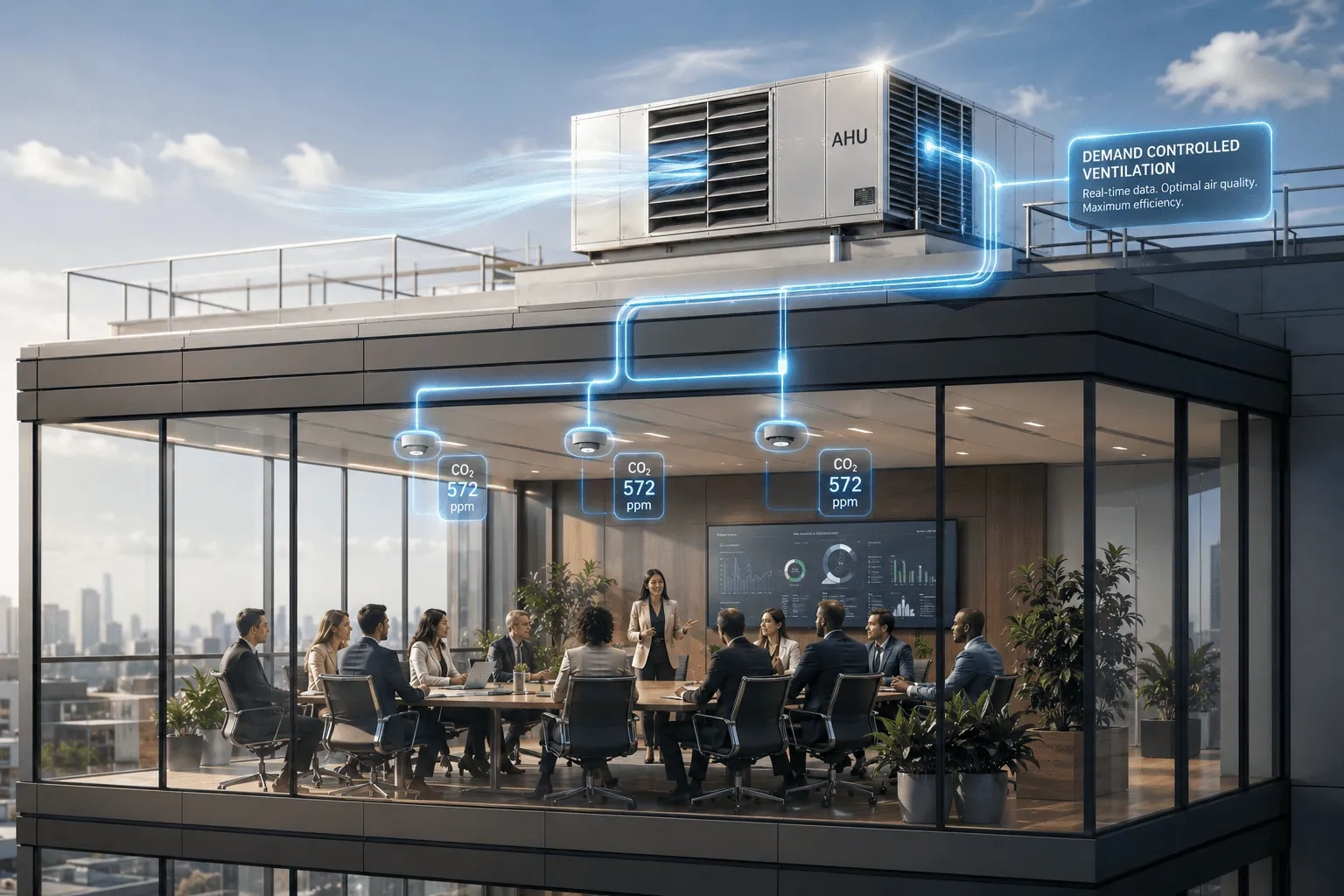
The solution isn’t just “more air,” but Demand Controlled Ventilation (DCV). This approach uses CO2 sensors placed in high-density zones, like conference rooms or open-plan workstations, to tell the Air Handling Unit (AHU) exactly when to open the vents. When the room is empty, the system throttles back. When it’s full, it ramps up. This prevents the “stuffy room” phenomenon without blowing your energy budget.
Is smart sensing actually worth the investment?
You’ll hear a lot of talk about IoT and “smart” buildings, but the value only exists if the sensors are calibrated correctly. A cheap sensor that drifts over six months is worse than no sensor at all, because it gives you a false sense of security while your staff is suffocating. Look for NDIR (Non-Dispersive Infrared) sensors. They are more expensive up front but hold their accuracy over time. If you are managing a 50,000 square foot facility, the energy savings from not over-ventilating empty zones usually cover the sensor cost within 18 to 24 months.
Can you improve air quality without replacing the whole system?
Yes, and you usually should start there. Many older buildings have VAV (Variable Air Volume) boxes that are stuck in a manual position or dampers that have rusted shut. Before you rip out the ductwork, have a technician perform a duct leakage test and check the static pressure. Often, the “air quality” problem is actually a distribution problem. You might have plenty of fresh air at the AHU, but it’s not reaching the center of the floor because of poor balancing. Adding smart actuators to existing dampers is a pragmatic way to modernize without a full overhaul.
Optimizing commercial ventilation systems for the Indian climate
The Indian context adds a layer of complexity: extreme humidity and high particulate matter (PM2.5). In cities like Delhi or Bangalore, bringing in “fresh” air during smog season can actually degrade indoor air quality if you don’t have the right filtration strategy. A standard MERV 8 filter won’t cut it when the outdoor air is thick with pollutants. You need a multi-stage approach, likely starting with a pre-filter to catch the big stuff and following up with MERV 13 or 14 filters to handle the fine particulates.
However, higher-grade filters create more pressure drop. If your fans aren’t powerful enough to push air through those denser filters, your airflow drops, and your indoor air quality (IAQ) plummets. This is where Variable Frequency Drives (VFDs) become mandatory. A VFD allows the motor to speed up to compensate for the filter resistance, ensuring that the cubic feet per minute (CFM) of fresh air remains constant regardless of filter loading.
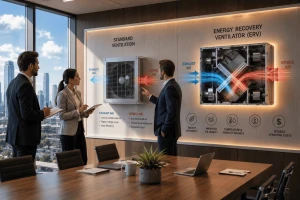
Another overlooked factor is enthalpy. In a humid climate, simply bringing in outside air adds a massive latent load to your system. Using an Energy Recovery Ventilator (ERV) allows you to transfer heat and moisture between the outgoing stale air and the incoming fresh air. It’s essentially a heat exchanger for your ventilation. By pre-cooling and de-humidifying the incoming air using the exhaust stream, you reduce the strain on your AC maintenance routines and lower your monthly electricity bills.
Do I need UVGI or ionizers in my ducts?
There is a lot of marketing noise around UVGI (Ultraviolet Germicidal Irradiation) and ionization. UV lamps are great for preventing mold growth on the cooling coils, which is a huge problem in humid Indian cities. If your coils are slimy, your air quality will suffer regardless of how much fresh air you bring in. However, using UV for “cleaning” the air as it passes through the duct is largely ineffective because the air moves too fast for the UV light to kill the pathogens. Stick to UV for coil maintenance and high-efficiency filters for air cleaning.
How do I handle “dead zones” in large open offices?
If you have a large open-plan office, you likely have “dead zones” where air just sits. This happens because the supply and return vents are poorly placed, creating a short circuit where the air goes in and immediately goes back out without circulating through the breathing zone. The fix isn’t always more power. Sometimes, adding destratification fans or adjusting the diffuser vanes to push air further into the room is the answer. You can verify this with a simple smoke pencil test to see exactly where the air is flowing and where it’s stalling.
The most expensive ventilation system in the world is useless if the building envelope is leaking. If your windows don’t seal and your doors are always open, you are fighting a losing battle against the outdoor environment.
When we audit systems, we often find that the Building Management System (BMS) is overriding the smart sensors because someone manually set the system to “Max” three years ago and never changed it. This is a common failure in HVAC installation projects where the hand-off from the contractor to the facility manager is poorly documented. You must ensure that your automation logic is transparent and that the staff knows how to interpret the IAQ dashboards.
One practical tip for those managing older stock: check your exhaust fans. If your exhaust isn’t keeping up with your supply, you create positive pressure that can push air into wall cavities and ceilings, leading to moisture buildup and mold. A balanced system is a healthy system. You want a slight positive pressure to keep dust out, but if it’s too high, you’re just wasting energy pushing air through the cracks in your walls.
For businesses looking to scale, integrating smart ventilation with your broader commercial cooling strategy is the only way to maintain a healthy environment without bankrupting the company. It requires a shift from a “reactive” mindset to a “predictive” one, where sensors tell you when a filter is clogged before the air quality drops, rather than waiting for a tenant to complain.
If you are tired of guessing whether your office air is actually fresh or just recirculated dust, it is time to stop relying on outdated timers and start using data. Upgrade your commercial ventilation systems to a demand-based model to protect your people and your bottom line.
Ready to stop wasting energy on empty rooms? Contact CoolLine today for a professional audit and installation of smart ventilation solutions.
Frequently asked questions
How often should I replace filters in a commercial system?
In Indian urban environments, you should check filters every 30 days. Depending on the pollution levels, you’ll likely need to replace pre-filters every 2 to 3 months and high-efficiency filters every 6 to 12 months. Using pressure gauges (manometers) is the only way to know for sure when a filter is actually clogged.
What is the ideal CO2 level for an office?
Outdoor air is around 400 ppm. For a productive indoor environment, you want to keep levels below 1,000 ppm. Once you hit 1,200 to 1,500 ppm, cognitive function drops and drowsiness increases, which is why your team feels a “mid-afternoon slump.”
Does smart ventilation lower my electricity bill?
Yes, because it prevents the system from cooling and dehumidifying outdoor air when the building is unoccupied or low-density. By reducing the volume of air treated, you lower the load on the compressors and fans.
Is an ERV better than a standard exhaust fan?
An ERV is significantly better for energy efficiency. While an exhaust fan just dumps conditioned air outside, an ERV recovers the “coolness” from the exhaust air and uses it to pre-cool the incoming fresh air, reducing the work your AC has to do.
Can smart ventilation help with virus control?
Yes, by increasing the air exchange rate and reducing the recirculation of contaminated air. Combining smart ventilation with high-MERV filtration and UV-C coil treatment is the most effective way to reduce airborne pathogen transmission in a commercial space.