
Unlock Smarter Cooling Why Inverter Split ACs Are Ideal for Indian Climates

Most people buy an AC based on the star rating on the box, but they ignore the actual thermal load of their room. If you have a room with a west-facing wall in Delhi or Mumbai, a standard fixed-speed AC will fight a losing battle, cycling on and off every few minutes and spiking your electricity bill. Understanding inverter split AC benefits comes down to one thing: the ability to modulate power rather than just slamming the compressor on and off.
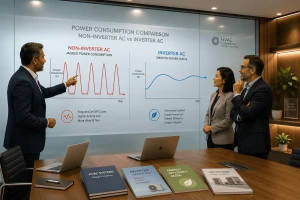
In a typical non-inverter system, the compressor is binary. It is either 100% on or 100% off. When the room hits the set temperature, the system shuts down. As soon as the temperature rises by one or two degrees, the compressor kicks back in with a massive surge of current. This cycle creates those annoying temperature swings where you feel chilled for ten minutes and then slightly sticky for the next five. It also puts immense strain on your electrical wiring and the compressor itself.
An inverter AC changes the game by using a variable speed compressor. Instead of shutting off, it slows down to a crawl once the room is cool. It maintains a steady state, which is where the real efficiency happens. For anyone managing a business or a large household in India, this isn’t just about comfort; it’s about reducing the peak load on your electrical panel.
The practical reality of inverter split AC benefits in high-humidity zones
India isn’t just hot; it’s humid. In coastal cities like Chennai or Kolkata, the latent heat (the moisture in the air) is often a bigger problem than the actual temperature. Fixed-speed units struggle here because they often over-cool the air before they manage to remove the humidity, leaving you feeling cold but clammy.
Because an inverter unit runs continuously at a lower speed, it provides more consistent dehumidification. It pulls moisture out of the air steadily rather than in bursts. This means you can often set your thermostat two degrees higher and still feel cooler because the humidity is actually under control. If you are looking for professional help with installation, you can check our installation services to ensure the unit is placed for maximum airflow.
Is the higher upfront cost actually worth it?
This is where the skepticism usually kicks in. Yes, an inverter unit costs more upfront. However, the math changes when you look at the operational expenditure. In a typical Indian household where the AC runs 8 to 10 hours a day during peak summer, the energy savings usually offset the price difference within 18 to 24 months. If you only use your AC for two hours a day in a guest room, a fixed-speed unit might actually be the smarter financial move. But for primary bedrooms or offices, the inverter is the only logical choice.
Can you run these on a stabilizer?
Many modern inverter ACs come with built-in stabilizers, but don’t trust the marketing blindly. If your local grid has frequent, severe voltage drops, a dedicated external stabilizer is still a safer bet to protect the PCB (Printed Circuit Board). The PCB is the brain of the inverter AC, and it is the most expensive part to replace if it fries during a power surge.
Managing the “Tonnage” trap and cooling capacity
I see too many people undersizing their units to save money. They buy a 1.0 ton inverter AC for a room that clearly needs 1.5 tons. When an inverter AC is undersized, the compressor runs at maximum speed indefinitely. This completely cancels out the efficiency gains. You end up with a machine that consumes more power than a fixed-speed unit because it never reaches the “maintenance” phase where it can slow down.
When calculating your needs, account for the heat load. This includes the number of people in the room, the amount of glass in the windows, and whether the room is on the top floor directly under the terrace. For these calculations, it’s best to consult our HVAC consultation team to avoid the costly mistake of undersizing.
Another nuance is the ISEER (Indian Seasonal Energy Efficiency Ratio). Don’t just look at the star rating. Look at the ISEER value. A 5-star AC from one brand might actually be less efficient than a 4-star AC from another if the ISEER is lower. This is because the star rating is a category, but the ISEER is the actual measurement of how the unit performs over a full Indian summer season.
Do they really make a difference in noise levels?
They do, but specifically in the indoor unit. Since the compressor doesn’t kick in with a loud thud every ten minutes, the acoustic profile of the room remains stable. You don’t get that sudden “whoosh” of air and the accompanying mechanical vibration. For people who struggle to sleep through noise, this is a massive quality-of-life improvement.
What about the maintenance overhead?
Inverter ACs are more complex. They have more electronics and a more sophisticated refrigerant cycle. This means that if something goes wrong, you cannot just call a local handyman with a basic tool kit. You need a technician who understands DC inverter technology and can diagnose PCB errors. We emphasize regular preventative maintenance because a clogged filter in an inverter AC forces the compressor to work harder, which degrades the electronics over time.
The biggest mistake users make is treating an inverter AC like a traditional one by constantly changing the temperature setting. To get the most efficiency, set it to 24 degrees and let the inverter logic handle the rest.
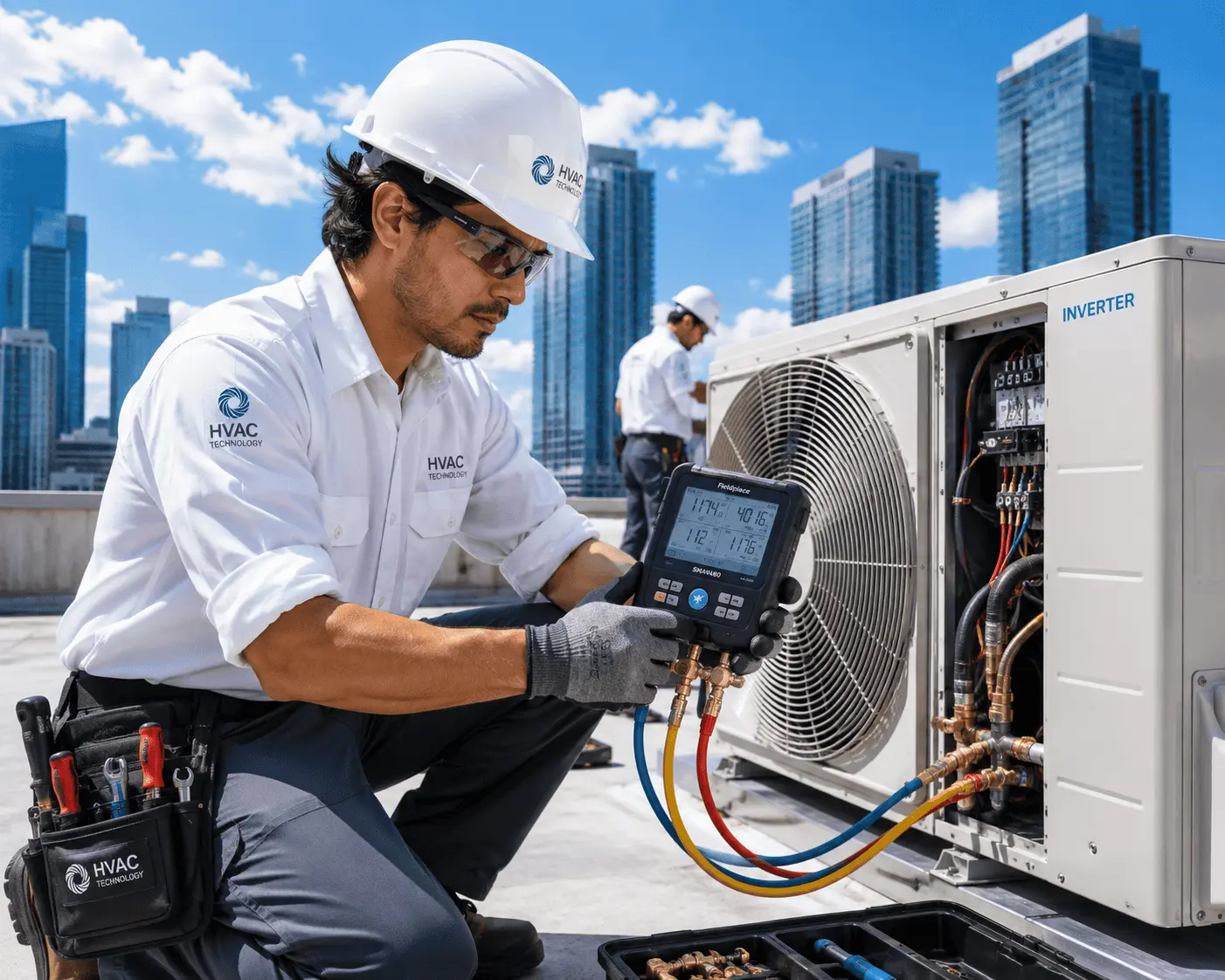
One final point on the refrigerant: most new units use R-32 or R-290. These are more efficient and have a lower global warming potential. However, they require specific handling. If a technician uses the wrong gauge or fails to vacuum the lines properly during installation, you will see a drop in cooling efficiency within six months, regardless of whether the unit is an inverter or not.
If you are noticing that your current unit is struggling or your bills are skyrocketing, it might be time to upgrade your hardware. Stop fighting the heat with outdated tech and switch to a system that actually adapts to your environment.
Ready to optimize your space? Get a professional assessment of your cooling needs and discover the real inverter split AC benefits for your specific layout. Visit our services page to get started.
Frequently asked questions
Does an inverter AC consume more power during the initial startup?
No, it actually consumes less. Unlike fixed-speed ACs that have a high starting current spike, inverter ACs start slowly and ramp up the speed gradually, reducing the initial load on your electrical system.
Which is better for a room that is rarely used?
If the room is used infrequently (e.g., a guest room), a non-inverter AC is often more cost-effective because the energy savings of an inverter unit require consistent run-time to pay off the higher initial cost.
Can I convert my old non-inverter AC into an inverter AC?
No, you cannot. The inverter technology is integrated into the compressor and the PCB. To get these benefits, you must replace the entire unit.
How long do inverter ACs typically last?
With proper maintenance and a high-quality stabilizer, they can last 10 to 15 years. The compressor lasts longer because it avoids the wear and tear of constant stop-start cycles.
Why is my inverter AC not cooling as much as my old one?
It might be because you are expecting a “blast” of cold air. Inverters maintain a steady temperature rather than over-cooling. Also, check if the unit is undersized for the room’s heat load.